In 1671, Robert Boyle fully described the reaction between iron shards and dilute acid that produced hydrogen gas. Between 1766 and 1781, “Henry Cavendish” was the first to realize that hydrogen gas is a separate substance and produces water when burned . He called it “Flammable Air”. Antoine Lavoisier chose the name hydrogen for this element , which is derived from its Greek roots, including the words (Hydro) meaning water and (Genes) meaning creator.
Table of contents of this article
Properties of hydrogen
Hydrogen reactions
Uses of hydrogen
Hydrogen in nature
Other sources of hydrogen
Isotopes
For the first time in 1898, “James Dewar” turned hydrogen into a liquid using the method of “Regenerative Cooling” and his invention called “Vacuum Flask”. He also produced solid hydrogen the following year.

Hydrogen is a colorless, odorless and tasteless gas that is the most abundant element on earth. This element is known as the lightest element in terms of atomic mass, whose atom contains one proton and one electron and no neutrons. This element can be found everywhere. Traces of hydrogen are found in water, fats , crude oil , hydrocarbons , fatty acids , carboxylic acids , sugar, ammonia , hydrogen peroxide and many other substances.
The following table shows general information about this atom:
| Atomic number | symbol | atomic weight | Electronic arrangement | oxidation number | Atomic radius | melting point | boiling point | Elemental classification | Properties at room temperature |
| 1 | � | 1.0079 | 1�1 | 1−1 | 78 ± | −259.34 �∘ | −252.87 �∘ | non-metal | Colorless and odorless diatomic gas |
Properties of hydrogen
Hydrogen belongs to the category of non-metals and its place in the periodic table is above these metals , due to the electron arrangement and the similarity of this arrangement to alkali metals . Of course, this element does not have the same properties as alkali metals because, unlike alkali metals, it is easily a cation�+does not constitute The proof of this claim is the high ionization energy compared to this group of metals. Ionization energy (ionization) of hydrogen is equal to1312 ��/���while the ionization energy of lithium is equal to520 ��/���has it.

Since hydrogen is a non-metal and the formation�−gives, in some cases it is placed above the halogens . This element also forms diatomic molecules like the halogens. Attractive forces between molecules�2It is very weak, which results in low melting and boiling points. However,�2It has very strong intermolecular forces and because of this, reactions �2At room temperature, they are generally done at a low speed. molecule �2It is simply activated by heat , irradiation and catalyst , and active hydrogen gases react quickly and exothermicly with many materials .

Also, this atom has the ability to form covalent bonds with many substances, because strong bonds�−�makes also �2It acts as a suitable reducer for metal oxides. For example, in the following reaction, �2(�)By passing through���(�),��2+To��It reduces and oxidizes itself.
���(�)+�2(�)→��(�)+�2�(�)
Hydrogen reactions
Hydrogen behaves both like alkali metals and halogens, whose reactions are given below:

�(�)→�(�)++�−
�(�)+�−→�(�)−
Reaction of hydrogen with active metals
Hydrogen takes the electron from the active metal and ionic hydrides such as���Forms. The reaction of hydrogen with the metals of group I of the periodic table is given below. In this reaction,�It represents alkali metals:
�(�)+�2(�)→��2(�)
Example :
��(�)+�2(�)→���2(�)��(�)+��2(�)→����2(�)
The reaction of hydrogen with alkaline earth metals is given below, this time,�It represents alkaline earth metals:
�(�)+�2(�)→��2(�)
Example:
��(�)+�2(�)→���2(�)��(�)+��2(�)→����2(�)
Reaction of hydrogen with nonmetals
Unlike metals that form ionic bonds with nonmetals, the bonds between hydrogen and nonmetals are covalent.
Hydrogen Halide→Halogen + hydrogen
�2(�)+��2(�)→���(�)
The reaction of hydrogen with oxygen produces a lot of heat:
�2(�)+�2(�)→�2�(�) Δ�=572��
Reaction of hydrogen with transition metals
The reaction of hydrogen with intermediate elements (metals) causes the production of metal hydrides. There is no fixed ratio of hydrogen atoms to these metals because, in fact, hydrogen atoms fill the voids between the crystal structures of these metals.
Uses of hydrogen
Most of the hydrogen that is produced industrially today is the result of processing methane gas with steam or producing “water gas” (water gas) from the reaction of coal with steam. Most of the hydrogen produced in the Haber process is used to produce ammonia.
Hydrogenation
Also, this element is used for “hydrogenation” of vegetable oils to turn them from liquid to solid, like margarine butter. In addition, liquid hydrogen is also used in rocket fuel because, as mentioned, the combination of hydrogen and oxygen produces a lot of energy. In addition, since hydrogen is a suitable reducer, it is also used to produce metals such as iron , copper, nickel and cobalt.
air ship
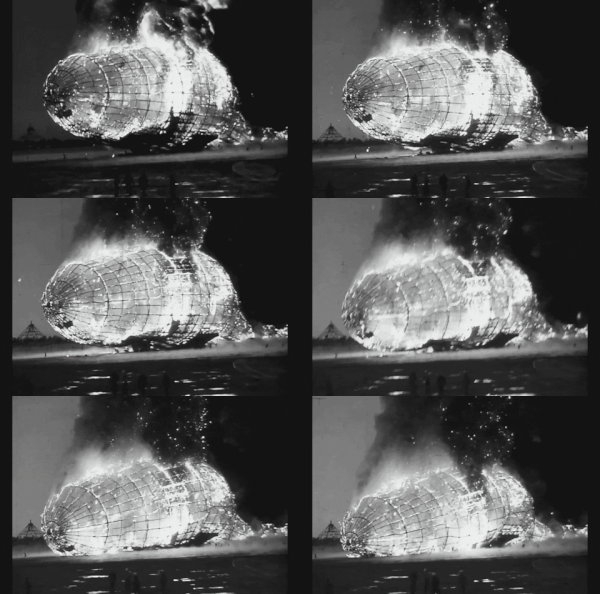
One cubic meter of hydrogen can lift more than 300 grams of the same material from the ground, which fueled the use of airships in the early 19th century. Of course, the use of this gas became obsolete during the Second World War because it had caused severe explosions in some cases. After the events of the World War and the explosions caused by this gas, it was decided to use noble gases such as helium.
Alternative to fossil fuel
Due to the need to find a suitable alternative to fossil fuels , in recent decades, research has been done on this element so that it can be considered as a source of energy. Due to the high energy contained in liquid hydrogen and compressed hydrogen gas, their use as future fuel is not out of mind. One of the positive points of this fuel is that it is clean because only water is produced when it burns. Of course, this work will be very expensive with today’s technologies.

Combustion of fuels produces a lot of energy that can be converted into electrical energy by turning a turbine. Of course, this work has a low efficiency because a lot of energy is lost as heat. Electricity generation through voltaic cells is more efficient. Voltaic cells that convert chemical energy into electrical energy are called ” Fuel Cells”. Since these cells do not operate automatically, they cannot be considered as a battery .

Hydrogen cells
A hydrogen cell is a type of fuel cell in which the reaction between�2(�)And�2It causes the formation of water and its efficiency is more than twice the efficiency of the best internal combustion engine . In the cell and under alkaline conditions, oxygen is reduced in the cathode and at the same time hydrogen is oxidized in the anode. Of course, using this technology is very expensive and cannot be used in everyday life.
Reduction reaction:O2(g)+2H2O(l)+4e−→4OH−(aq)
Oxidation reaction:H2(g)+2OH−(aq)→2H2O(l)+2e−
General reaction:2H2(g)+O2(g)→2H2O(I)

Hydrogen in nature
Hydrogen is known as the fuel required for reactions in the sun and other stars. This element is the lightest and most abundant element in the universe. Between 70 and 75% of the universe is made up of hydrogen. In fact, all stars are large bodies of this gas that produce a huge amount of energy through the process of hydrogen fusion. In smaller stars, hydrogen atoms are converted into helium and other lighter elements such as nitrogen and carbon due to collisions and fusion. In larger stars, this atom will produce heavier elements such as calcium, silicon and oxygen.

In the earth’s atmosphere , this element is usually combined with oxygen and in the form�2�Can be found. Pure hydrogen accounts for 15% of the Earth’s volume and 0.9% of its mass, while water makes up 70% of the Earth’s surface. Since hydrogen has very little weight, its concentration in the atmosphere is only0.5 ���is that due to its flammability, it will be a suitable concentration.
Other sources of hydrogen
Hydrogen gas can be produced by reacting a strong dilute acid such as hydrochloric acid with an active metal. In this reaction, the metal turns into oxide and�+From the acid, it is reduced to hydrogen gas in an oxidation and reduction reaction. This method can be used for laboratory production of hydrogen in a small amount, but it is an expensive method for industrial use. An example of this reaction is given below:
��(�)+2�(��)+→��(��)2++�2(�)
The purest kind�2(�)can be obtained from electrolysis�2�(�)got. Of course, this reaction is also not economical because it requires a rich source of energy:
2�2�(�)→2�2(�)+�2(�)
�2�It is the most abundant in the earth. As a result, it is not far-fetched to want to obtain hydrogen from electrolysis of water. For this, you need hydrogen with an oxidation number +1to hydrogen with oxidation number0convert Three of the most important reducing agents used for this purpose are carbon (coke or coal), carbon monoxide, and methane. These substances react with water vapor and form�2(�)they give. It should be noted that these three methods are also used for the industrial production of hydrogen gas due to their cost-effectiveness:
�(�)+2�2�(�)→��(�)+�2(�)��(�)+2�2�(�)→��2+�2(�)��4(�)+�2�(�)→��(�)+3�2(�)

Isotopes
Hydrogen naturally has three isotopes named “protium”, “deuterium” and “tritium”.
proteome
The most abundant isotope of this element is 98.99% of hydrogen in nature. The nucleus of this atom has only one proton and no neutrons, which makes it1�They show.
Deuterium
Deuterium is another isotope that has one proton and one neutron in its nucleus. This type of isotope makes up only 0.0156% of hydrogen in nature. Its symbol is usually in the form of�Or2�And it is called heavy hydrogen. This isotope can be obtained by partial distillation of liquid hydrogen or by long-term electrolysis of water. to produce one gallon (78.3 liters) of “heavy water”(�2�), about 100 thousand gallons�2�we need This type of water has a higher density , melting and boiling point than normal water and is used in nuclear reactors as deuterium fuel. Substitution of protium with deuterium has important applications in researching the mechanism of “Kinetic Isotope Effect” reactions.
Tritium
Tritium that it is shaped3�They show that it has two neutrons in its nucleus. The isotope has radioactive properties and its half-life is about 3.12 years. This isotope is continuously produced outside the earth’s atmosphere due to cosmic rays. Tritium can also be produced in a nuclear reactor with the help of lithium-6 isotope. In addition, the same isotope is also used in hydrogen bombs. Most tritium is made by bombarding lithium with neutrons. This isotope is also used in nuclear fusion reactors.

If this article was useful for you, the following tutorials are also recommended for you:
- A collection of chemistry lessons
- A collection of chemical engineering software training
- Learning about water purification by reverse osmosis (RO) method with ROSA software
- Plating – in simple words